







Welcome back to the Lovecraft reread, in which two modern Mythos writers get girl cooties all over old Howard’s original stories.
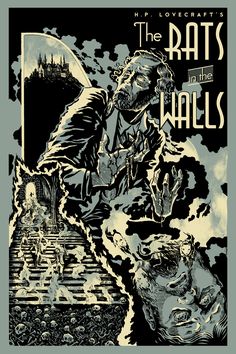
Today we’re looking at “The Rats in the Walls,” written in August-September 1923, and first published in the March 1924 issue of Weird Tales. You can read it here.
Spoilers ahead.
“These rats, if not the creatures of a madness which I shared with the cats alone, must be burrowing and sliding in Roman walls I had thought to be of solid limestone blocks […] unless perhaps the action of water through more than seventeen centuries had eaten winding tunnels which rodent bodies had worn clear and ample. […] But even so, the spectral horror was no less; for if these were living vermin why did not Norrys hear their disgusting commotion?”
Summary: Delapore is last of his line, for his only son has died of injuries received during WWI. Grief-stricken, he devotes himself to restoring Exham Priory, his family’s former seat in England. It’s tumbled to ruin since the early 1600s, when Walter de la Poer killed father and siblings and fled to Virginia. Walter was more honored than despised for his actions—the cliff-perched priory was an object of fear long before it passed to the de la Poers.
Neighbors still hate Exham Priory, but antiquarians prize it for its peculiar architecture. A Druidic or pre-Druidic temple is its basis. The Romans built on top of that, followed by the Saxons and Normans. The original cult’s rites infiltrated the Romans’ Cybele worship and the Saxons’ early Christianity. A dubious monastic order planted oddly extensive gardens and terrified the populace. Previously of unsullied reputation, the de la Poers inherited the curse with their acquisition. Family members of a certain temperament, including those by marriage, appeared to form an inner cult; members of healthier inclinations tended to die young.
Delapore collects country tales of bat-winged devils holding Sabbath at the priory, of unsolved disappearances, of Lady Mary de la Poer killed by her husband and mother-in-law, with the blessings of their confessor. The most dramatic stories involve an army of rats that burst from Exham after Walter deserted it, devouring livestock and hapless humans before dispersing.
But Delapore’s a skeptic. He braves the antipathy of neighbors unhappy with his return and reclaims the “de la Poer” spelling; only his son’s war-time friend, Captain Edward Norrys, welcomes and assists him. Delapore lives with Norrys for two years while workmen restore the priory, medieval glory improved by cleverly camouflaged modern amenities. He moves in with seven servants, his beloved black cat whose unfortunate name starts with N (hereafter referred to as Cat With an Unfortunate Name or CWUN for short), and eight other felines he’s collected.
His study of family history is soon disrupted by the cats’ restlessness. A servant fears rodents, but there’ve been no rats in the priory for three hundred years, and mice have never strayed into the high walls. Nevertheless, Delapore begins to hear nightly scurrying in the walls of his tower bedroom, and CWUN is driven to frenzy trying to get at them. By their noise, the rats are heading downward, and the other cats congregate at the subcellar door, howling. Traps are sprung, but capture nothing. Only Delapore and the cats hear the rats, a fact which intrigues Norrys.
He and Delapore camp in the subcellar, where Roman inscriptions grace the walls. Several altar-like blocks date from the aboriginal temple. Delapore has a recurring dream in which he sees a twilit grotto and a swineherd driving fungous beasts of loathsome aspect. Norrys laughs when the dream wakes Delapore screaming, but he might sober if he knew whose features Delapore finally spied on one of the beasts.
Nor does Norrys hear the subsequent scurry of rats, cascading downward—as if the subcellar isn’t the priory’s lowest point. CWUN claws the central altar; when Norrys scrapes lichen from its base, a draught reveals some passage hidden beyond.
They debate leaving the mystery alone or braving whatever lurks below. A middle course seems wisest: Call in experts. They round up suitable authorities, including archaeologist Brinton and psychic Thornton. No scurrying rats disturb Delapore’s return; Thornton suggests they’ve already done their job leading Delapore to… something. Probably something delightful, we’re sure.
Brinton shifts the altar. The party descends into a grotto lit by rifts in the cliff-face. It extends into darkness, but they see enough: a sea of skeletons, more or less humanoid. Most are lower on the evolutionary scale than Piltdown man, and some are quadrupeds—the flabby beasts of Delapore’s dream! Structures dot the grottoscape, from prehistoric tumuli to an English building with seventeenth-century graffiti which appears to have been a butcher shop. The diet of the various cults is clear but doesn’t bear pondering.
CWUN stalks through these horrors unperturbed. Delapore wanders toward refuse pits in which rats must have feasted before hunger drove them to marauding frenzy. In the depths beyond, he hears rodent scurrying. He runs forward in an ecstasy of fear. The rats will lead him ever on, even to caverns where Nyarlathotep, mad and faceless, howls to the piping of amorphous flute-players!
Three hours later the investigators come on Delapore muttering in every tongue from modern English through Latin to primordial grunts. He’s crouched over Norrys’ half-eaten body, plump and flabby as that fungous beast that wore his features. CWUN tears at his master’s throat.
They destroy Exham Priory soon afterwards. Delapore, confined to an asylum, denies he ate Norrys. It must have been the rats, the demon rats that even now race behind his cell’s padding, the rats they can’t hear, the rats in the walls.
What’s Cyclopean: Delapore dreams of “fungous, flabby beasts.” Lovecraft uses so many words very exactly (including “cyclopean,” most of the time); inquiring minds would like to know exactly what he thinks “fungous” means.
The Degenerate Dutch: You’d think CWUN would be the main item here—it’s certainly the one that people tend to remember. But then there’s “the negroes howling and praying” at the arrival of the Union, clearly distraught at the disruption to their own beloved way of life (or not). And there’s the carefully laid out evolutionary ladder between ape and humans of supreme sensitivity. Evolution: it does not do what you think it does. “You” in this case being early 20th century eugenicists.
Mythos Making: Just when you think it’s all going to be Cybele and the Magna Mater, there’s a rant about Nyarlathotep. And of course, as always, cats stand ready to fight against whatever horrors present themselves.
Libronomicon: No books, but lots of half-effaced Roman carvings and some English graffiti.
Madness Takes Its Toll: De la Poer ends up in an asylum, actually a relatively rare fate for Lovecraft’s narrators.
Ruthanna’s Commentary
It’s a well-replicated psychological finding that taboo words are extremely distracting—if you want people to forget the details of something, put it next to an obscenity. And indeed, the only thing I remembered of this story was the cat’s name, and that there were horrible rat-like things far underground. Which is too bad, because it’s actually an extremely effective horror story.
After “Silver Key,” I’m primed to appreciate a good Mythos story. Real-world current events and sensible scientific protocol make a solid contrast for the horror beneath the cliff, and for the narrator’s own psychological breakdown. Warren G. Harding really did die of a heart attack that week. Calling in archaeologists is, in fact, the right thing to do upon discovering a new layer of construction underneath your already impressively layered house—although Lovecraft resists the temptation, for once he could have gotten away with calling the place “ancient.” (Exham Priory reminds me of Rome’s San Clemente—the sort of place that will give anyone shivers, of pleasure or awe or fear according to their wont, thinking about the weight of human habitation.)
Although we only get one call-out to the “traditional” Mythos gods, we get echoes—or premonitions—of several other stories. There are parallels with “The Lurking Fear,” which he wrote less than a year earlier: old house, scary family, and apified humans. Then there are the “quadruped things,” implied to have human ancestry themselves… if the De la Poers aren’t Martense relatives, do they carry a little K’n-yan blood? The Mound won’t be written for another 6 years, but I wouldn’t be shocked if the underground setting there drew a bit on this one.
Some of the most interesting connections are with “The Festival,” also yet-to-be-written at this point, though not by much—he finished Rats in September 1923 and wrote Festival in October. And here’s an underground cavern of slightly ambiguous reality, alongside the image of an oily river filled with horrors—and Nyarlathotep howling, faceless, to the piping of amorphous idiot flute players. Maybe he howls as a tower of green flame?
Cybele is the only known Phrygian goddess, later incorporated into the worship of Gaia and Demeter. In Greece there were mystery cults to her, with much drinking and carousing, and Atys was her eunuch shepherd-consort. Orgies were probably not out of the question. Rats seem unlikely given that they tend to eat grain rather than produce it. But the “Great Mother” probably sounded pretty scary to ’20s readers (and would still sound scary to many modern readers, albeit not those who usually read Lovecraft in the first place), whereas modern genre readers are used to the Pagan-with-the-serial-numbers-filed-off religions mostly being good guys. Not to mention readers who are actually Neopagan. No comment on whether Cybele’s modern worship involves drinking, carousing, etc. Probably not rats and vast underground edifices, though—those things are expensive.
Other interesting references—Trimalchio is a 1st century CE Roman satirical character, who throws lavish feasts including one at which the guests act out his funeral. Roman themes run through the story, to mostly good effect.
The ending is intriguing, and more effective for the rest of the story’s groundedness. Delapore’s already said, very rationally, that he needs to choose his words carefully—and then starts running through a landscape grown suddenly amorphous, crying about Nyarlathotep, channeling ancestral voices of increasing antiquity—and perhaps becoming, or invoking, or manifesting rats that no one else can hear. The rats are suddenly amorphous as well, both descriptively (gelatinous!) and metaphorically (the rats of war who ate his son). Cosmic horror, once again, maps to a more immediate and personal apocalypse.
Anne’s Commentary
“The collective unconscious comprises in itself the psychic life of our ancestors right back to the earliest beginnings. It is the matrix of all conscious psychic occurrences, and hence it exerts an influence that compromises the freedom of consciousness in the highest degree, since it is continually striving to lead all conscious processes back into the old paths.”
— Carl Jung, “The Significance of Constitution
and Heredity in Psychology” (1929)
“So we beat on, boats against the current, borne back ceaselessly into the past.”
— F. Scott Fitzgerald, The Great Gatsby (1925)
I’m not sure whether Lovecraft ever became a big fan of Gatsby, but we do know he was aware of Jung—in Supernatural Horror in Literature, he notes that Irvin Cobb introduces “possible science” into a story about a man who reverts to an ancestor’s language when hit by a train. The ancestor was hit by a rhino, nature’s purest locomotive analog.
Delapore definitely loses his “freedom of consciousness” when caught up in the cataract of ancestral memory that is Exham Priory. That ancestry extends into the “hereditary” memory of the species, as it variously shambled and strode on two legs or devolved to quadruped wallowing, the better to munch on coarse vegetables and provide haunches for Exham cultists. Significantly, the de la Poers were perfectly respectable until they took over the priory. Something strange happened then, but not, I infer, for the first time. Whatever haunts the place—whatever psychically pervades it—seems to pervert the susceptible among any occupying group, twisting the Romans’ Cybele-worship and the Saxons’ Christianity into versions of the original religion. Which was what? Something older than Druids, sounds like. Some archetype of darkness and anticivilization, suitably embodied in cannibalism.
I’m thinking occult expert Thornton was right. Certain forces prevail in Exham Priory, that used the ghostly rats to lead Delapore to the heart of his heritage. To bear him relentlessly into the past until it possesses him and pours out his throat in all the tongues the priory has known. Could be the “certain forces” are inherent to humanity—the collective unconscious which is our psychic history, or the anarchic beast that contends with the angelic side of our natures. Could also be—a Mythosian notion—that the ultimate source of evil is in fact a core reality which is amoral and chaotic, a mad and faceless god serenaded by idiots without shape or, one supposes, a great sense of rhythm.
Interesting that Delapore refers to this god as Nyarlathotep rather than Azathoth, whom the description better fits. Maybe Delapore doesn’t know his Outer Gods very well, or maybe Nyarlathotep wears his Azathothian avatar for the Exham folks, or maybe we’re just still early days, Mythos-wise, with deific classification in its primitive stages.
Anyhow, on to the animals. Lovecraft named Delapore’s cat after his own beloved pet, and then there’s the Ward family cat, Nig, and at least two notable black kittens in the Dreamlands stories, maybe fortunately left without names. He loved him some cats, and gives this one a starring role, at the same time acknowledging the trope of the animal-more-psychically-sensitive-than-humans. CWUN rises in the end to unperturbed observer of the grotto’s horrors, “winged Egyptian god” darting toward the heart of the mysteries, and avenging spirit leaping at his own master’s throat—or maybe a harsh savior, trying to bring that master back to himself. The rats are kind of sympathetic, with their tiny little bones mixed up with the grosser skeletons. After all, they were just obligingly cleaning up the charnel pits. It wasn’t their fault the food source played out, forcing them to look for fresh provender. They make for cool, slithery, scampery ghosts, too.
But we’ll have to wait for “Dreams in the Witch-House” for the ultimate Lovecraft rodent.
Animalistic but with clear human origins is the grotto livestock. In Lovecraft’s universe, people are pretty quick to devolve into the bestial—see also the Martenses of “Lurking Fear” and (at least to the pre-sympathetic narrator) the hybrids of Innsmouth. What does it mean that Delapore sees Norrys’ features on one beast? Seems probable that the Norrys family has a long history in the Exham area. Did some of them fall prey to the priory cult? Ironic, then, that Norrys should befriend Delapore, and that he should end up a Delapore’s dinner himself.
The wealth of detail in this short story could make a long novel. What about the squishy white thing John Clave’s horse stepped on, and Lady Margaret Trevor de la Poer, kid-bane? What of Randolph Delapore, voodoo priest? What of the great rat-tsunami itself? On the whole Lovecraft does a good job balancing background and immediate plot; the details intrigue rather than distract, and they remain a tantalizing bunny buffet for us latter day plot-scavengers.
Next week, we continue wending our way through Randolph Carter’s story—and learn what happens when you edit fanfic of your own stuff—in Lovecraft and E. Hoffman Price’s “Through the Gates of the Silver Key.”
Ruthanna Emrys’s neo-Lovecraftian novelette “The Litany of Earth” is available on Tor.com, along with the more recent but distinctly non-Lovecraftian “Seven Commentaries on an Imperfect Land.” Her work has also appeared at Strange Horizons and Analog. She can frequently be found online on Twitter and Livejournal. She lives in a large, chaotic household—mostly mammalian—outside Washington DC.
Anne M. Pillsworth’s short story “Geldman’s Pharmacy” received honorable mention in The Year’s Best Fantasy and Horror, Thirteenth Annual Collection. “The Madonna of the Abattoir” is published on Tor.com, and her first novel, Summoned, is available from Tor Teen. She currently lives in a Victorian trolley car suburb of Providence, Rhode Island.

This really is an excellent story. HPL does a very good job, for once, of providing enough historical and folkloric background without overwhelming the reader with details. Compare this with “The Shunned House” for example, with its lengthy history of the house and all that happened to the people in it.
I found myself actually worrying about CWUN when they descended below the altar. I knew I shouldn’t have, since Lovecraft will rarely allow something bad happen to a cat and this one in particular was named for a beloved family cat.
Alas, CWUN’s unfortunate name, or one with three fewer letters, was all too common for black cats and dogs. The dog who was an integral part of the Dam Busters squadron had the shorter version. Which is now giving Peter Jackson (and Stephen Fry, who’s writing the screenplay) fits, since he wants to do a remake of the film and the dog was very important to the real squadron.
Apart from the unfortunate name, there was one other thing that jarred me while reading. At one point, the narrator describes the priory as “perched perilously upon a precipice”. That’s just a little too plosively alliterative for me.
I consider “The Rats in the Walls” to be overall an excellent story in the Machen vein, indeed, I would call it superior to the older author’s work. This is the first story to mention Nyarlathotep after “Nyarlathotep”, so put the inconsistency down to early days.
Weird Tales: March 1924 first, with “The Spirit Fakers of Hermannstadt” allegedly by Harry Houdini, Clark Ashton Smith’s “The Melancholy Pool” and Lovecraft and Eddy’s “Ashes”. Reprinted in June 1930, with the first part of Robert E. Howard’s Solomon Kane story “The Moon of Skulls”, Clark Ashton Smith’s “The Last Incantation” and August Derleth’s “Across the Hall”. Christine Campbell Thomson included it and “The Curse of Yig” in Switch on the Light (named, one can only presume, in a rare fit of imagination).
A True Story: When reading the following, please consider that at the time of the events described, I was not fully alert and ready to leap into battle but about to settle down to read the illustrated edition of ‘Salem’s Lot. This may account for some of my actions. I walked across the room and removed the book from its place on a shelf in a cupboard. I elected to read the two included short stories first, beginning with “One for the Road”. Nothing untoward happened then.
I noticed that the cupboard door, which I thought I had closed, was in fact still slightly open. No great problem, I walked over, shut the door and then collected a volume of Lovecraft from another shelf, so that I could read “The Rats in the Walls” before “Jerusalem’s Lot”. Again, the Lovecraft story passed without incident but during the second King, I became dimly aware of a scratching noise. Well, houses make noises, these things happen. During the section of deleted scenes, it came to my attention that the scratching had started again, this time somewhat louder.
This would have been less of a disturbance, had it not been accompanied by the distinct sound of something moving about within the cupboard. Now, what was in the cupboard? Well, books mostly. What was behind the cupboard? A wall.
Now, obviously, there couldn’t be anything in the cupboard because really, how likely was it that horrors from beyond had tunnelled through?
I formed the Elder Sign and resolved that the best way to resolve the situation was to open the cupboard and confront whatever was within. I did not attempt to gather any kind of improvised weapon. This was a good thing, in the long run.
I flung open the door and, for a moment, was transfixed by golden eyes.
I elected to spend the remainder of the evening re-reading Blandings Castle and Elsewhere and, after a while, ceased to notice the unwavering gaze of my now very wary cat.
In the audio version I have of this story, CWUN’s name is changed to Mr. Blackman. I would object strenuously to someone publishing HPL’s story with this change but for some reason changing the name in another medium (in this case, audio) doesn’t seem to bother me. Weird.
There is a real Hexham Priory, now called Hexham Abbey, with the oldest crypt in England, a 1,300-year-old Saxon crypt made partially with Roman material, so it does have actual Roman inscriptions.
Though it’s very atmospheric to go down into the darkness of the crypt, there’s nothing sinister about the modern church, and it’s not one of the places busted up in the Reformation and sold to a rich family.
This was one of the first Lovecraft stories I ever read – it was the first story in the “Best of” Del Rey anthology I owned. It wasn’t a bad introduction to Lovecraft’s straight-up horror (except for CWUN, of course, but other commenters are correct that the unfortunate name is actually kind of time-accurate).
I like how it works on two separate metaphorical levels, the first being a metaphor for WWI. The “army of rats” is pretty obvious and the descent below the house perhaps symbolizing the descent into actual wartime trenches (which were full of vermin – including, I’m sure, rats). The narrator’s degeneration and actions are a pretty nice stand-in for “shell-shock” and PTSD with the cannabalism and butchery symbolizing the very real horrors of WWI. I don’t know if there are any historical account of WWI soldiers practicing cannibalism, but given how completely horrific that war was, I wouldn’t rule it out…. (Side note: I was in England last summer during the 100th anniversary of WWI. I got to see the poppy exhibit around the Tower of London. It was gorgeous but also made it look like the Tower was sitting in a huge pool of blood. The British Library had an exhibit consisting of letters home from British soldiers who died during combat – SERIOUSLY heart-breaking.)
Since Lovecraft was so classist, I also like to see this as a metaphorical send-up of the decadence of the aristocracy. The de la Poer family pretty much destroys the ideal “noblesse oblige” feudal system, butchering and eating the populace they are “supposed” to be serving and protecting. It’s a nice change from so much of his “look at the terrible things uneducated, in-bred rural people do when someone is stupid enough to give them access to a DANGEROUS BOOK!” :P
“Evolution: it does not do what you think it does.” *lol* That makes me think of Morbo from “Futurama” – EVOLUTION DOES NOT WORK THAT WAY! Don’t forget, however, that Lovecraft wasn’t writing *that* chronologically far from Zola and the American naturalism movement and is kind of in dialogue with that. Just think of Edith Wharton’s “Summer” and, especially, Frank Norris’ “McTeague.” (Yeah, evolution REALLY does not work the way Norris thinks it does.)
@SchulyerH: Funny story and nice shout-out to King’s homage to “The Rats in the Walls,” “Jerusalem’s Lot. “Graveyard Shift” from the “Night Shift” collection, has a lot in common with this story as well.
Hello again, guys! Been away too long due to family medical leave.
@@@@@ DemetriosX I’m worried about the precipice perch, too, considering how honeycombed it is. Of course, the whole shebang’s been blown up now, like the Martense house. What’s with all the self-righteous destruction of uber-cool preternatural sites? And would the British antiquarian community really want to blow up Exham Priory, such a treasure-trove of the past?
@@@@@ SchuylerH I was once considering Exham Priory while washing dishes. In the over-sink window, I noticed a huge bat flying back and forth. Outside, I assumed, until I turned around to see it flying back and forth behind me — the bat in the window had been a reflection. It’s the curse of the de la Poer’s, I tell you! Though I’ll trade a bat in a kitchen for a cat in a cupboard any day.
@@@@@ tbob That’s an interesting observation. I think I read CWUN’s name has been changed in other reprints/iterations of the story, too. Black cat’s should just be named Anthracite in my opinion, or possibly Onyx. Or Ultimate Abyss. Or all three, if you’re not into the brevity thing: Anthracite O. Ultimate Abyss, Esq.
The Piltdown Man was a fake, a human skull with an orang utan jaw.
@5: There’s a case where the Germans used the threat of Maori cannibalism to try to stop their soldiers from to surrendering to New Zealand troops: at least the New Zealanders got a laugh out of it: http://historygeek.co.nz/2012/12/27/cannibals-in-the-trenches/
@6: If it’s anything like Warwick Castle, I can attest that Exham Priory would be standing today, rebranded as a major local tourist attraction and raking in millions in rat-themed merchandise.
While I remember, there’s a @LovecraftCat Twitter account (“My given name is unfortunate”) but it isn’t often active.
@7: I’m inclined to give Lovecraft a pass on that particular bit of dodgy science since it wasn’t demonstrated to be a fake until much later, when more recent contradictory fossil evidence encouraged a skeptical reassessment. More information here: http://www.nhm.ac.uk/nature-online/science-of-natural-history/the-scientific-process/piltdown-man-hoax/
@7/8
Yeah, I think we can give him a pass on Piltdown man. It wasn’t conclusively proven to be a fake until 1953. Clarence Darrow even cited it during the Scopes trial. In fact, the first time the skull was openly questioned by any anthropologists was 1923, the same year Lovecraft wrote this story.
@2, @5 This story, along with “The Dunwich Horror” was included in the landmark Modern Library anthology GREAT TALES OF TERROR AND THE SUPERNATURAL, published in 1944. It could be argued that this was the first significant appearance of Lovecraft’s stories in a book from a “mainstream” publisher.
Probably my favorite of Lovecraft’s stories. I heard an audio version with the cat’s name changed to Midnight, which didn’t work for me as the syllables were off (for those of you who haven’t read, it’s, well, N*****-man).
Still, change the cat’s name, expand the family history and Delapore’s grief over losing his son, and you’ve got something that might actually work on-screen.
@6 We named a female black kitten Umbra once. I would also accept Caliban for CWUN’s rename. It would at least fit the cadence of the story.
@SchulyerH: Thanks for the link! I LOVE the picture of the New Zealand soldiers grinning outside the “Cannibal Paradise Supply Den.” I almost can hear them thinking: “Haha! We INVENTED trolling!” :D
On a more serious note, here’s a really gorgeous WWI poem from the British Library exhibit I mentioned. It’s titled “For the Fallen” and was written by Laurence Binyon.
As the stars that shall be bright when we are dust,
Moving in marches upon the heavenly plain;
As the stars that are starry in the time of our darkness
To the end, to the end they remain.
Rats? And pipers? *chortle*
The phrase “rat tsunami” is quite shiver-inducing, however.
@6: I once suggested to a friend that she name her pet black heifer Abyssa. She didn’t.
@13: The fourth verse of “For the Fallen” is traditionally recited at Remembrance Day services:
“They shall not grow old, as we that are left grow old:
Age shall not weary them, nor shall the years condemn.
At the going down of the sun and in the morning
We will remember them.”
@SchulyerH: That’s beautiful! My research skills at the moment are apparently teh fail because I didn’t realize there was more to the poem (I copied down that stanza from the exhibit wall, if I remember correctly.)
I think it’s really tragic yet wonderful how much great literature came out of the horrors of WWI. I am NOT exempting Lovecraft here. While the Great War *obviously* didn’t have the same effect upon those of us in the U.S. as it did on those in Britain, mainland Europe, and elsewhere, it DID change the U.S. zeitgeist forever.
(If you aren’t already familiar with it, check out the long poem “In Parentheses” by David Jones.)
In Rats, I give Lovecraft a pass on a bunch of things that really do fall into “he was a product of his times.” The cat’s name, while unpleasant, was as others have pointed out pretty common. The bad eugenicist understanding of evolution was created by bad eugenicist researchers (I use “bad” in both the moral and methodological senses); he just overused it as a literary trope. Piltdown man was considered good science at the time, and not really anyone’s fault but the hoaxer. And got caught by about the same methods that just revived brontosaurus, which tells you just how common it is for fossil reevaluation to take a while.
This story was one of the set that my wife first read aloud to me when we were starting out with Lovecraft. She paused, narrowed her eyes, and announced very firmly, “We’re just going to call the cat Blackie.”
Off-topic–though not as off-topic as we frequently get around here: if anyone role-plays, either LARP or table-top, and would be willing to take 15 minutes to give your opinion on a Sekrit Projekt, please ping me privately.
The rat tsunami seems to come from the legend of Bishop Hatto, as related in Sabine-Gould’s Curious Myths of the Middle Ages:
http://www.gutenberg.org/ebooks/36127
And notice how often the narrator refers to Norrys as “plump” before the climactic scene. It’s as if his inner cannibal were lurking under the surface all along…
“Rats in the Walls”:One of my favorites.Maybe the best pre-“Call of Cthulhu” story?
Degneration in Lovecraft: Definitely a prime source of horror in his work. Of course, Lovecraft seems to have felt that degeneration/decay was inevitable.Only The Great Race of Yith are beyond the ravages of time.
Lovecraft and Robert E Howard: Fun sidenote.For the Celtic speech in the tale, Lovecraft lifted some lines from Fiona Macleod’s “The Sin-Eater.” HPL knew that the language, being Gaelic instead of Cymric, was innacurate, but he assumed that no one who read Weird Tales would notice.Well, when the story was reprinted in the June, 1930 issue of WT, Robert E Howard noticed, and wrote a letter to the editor about it.Farnsworth Wright (WT’s editor) sent the letter on to HPL, and the REH-HPL epistolary friendship began.
Dream-Quest of Unknown Kadath: Don’t know why, but I’m quasi-surprised that you are going to do “Through the Gates” before Kadath.Of course, since it was unpublished during HPL’s lifetime, and it does present certain chronological difficulties (a post “Pickman’s Model” Pickman turns up in it, which is hard to square with Carter losing the key to the gate of dreams when he was 30…)
Jaime Chris:”I think it’s really tragic yet wonderful how much great literature came out of the horrors of WWI. I am NOT exempting Lovecraft here. While the Great War *obviously* didn’t have the same effect upon those of us in the U.S. as it did on those in Britain, mainland Europe, and elsewhere, it DID change the U.S. zeitgeist forever.”
Yeah, the cultural impact of the Great War on the USA was immense.Just look at the all of the literature that was shaped by it: The Great Gatsby, Tender is the Night, A Farwell to Arms, The Sun Also Rises, Dos Passos’ Three Soldiers, What Price Glory?
This was my first Lovecraft, when I was eight or so, and one of the first horror stories of any kind I ever read; it fascinated me the way a rabbit freezes in front of a snake.
It’s still one of my favorites. There’s so much in it.
The two destroyed houses, for instance– the de la Poers’ Virginia plantation is a miniature of its hideous parent, a terrible place that eats human beings. When it comes down, the cousin, Randolph, may well be said to side with the forces that destroy it, depending on whether he is living among black people as an equal or not– we haven’t enough information. And the narrator just stands to the side, watching the house burn, unable either to abandon the past or to die with it. Reclaiming the Priory is a definitive statement on his part, siding with the past in the wreckage of his own present, despite the cost of that past. Because, after all, the cost of the past is to *others*, isn’t it, and not to the de la Poers.
I have no idea whether Lovecraft intended the houses to parallel each other consciously– would not be surprised either way.
De la Poer, as the typo I have now corrected three times indicates, of course means ‘of the Power’, from the medieval Anglo-French– a word which would have been current at about the time the family took over the Priory, and consequently possibly a new name for a new piece of real estate.
And I find it amusing that the Priory’s reign of terror ended during the reign of James the Sixth and First, author of a daemonology and persecutor of witches; it is true that at that time in England a man accused of murder in the cause of ending an ancient witch-legend would not have been chased very hard.
I suspect ‘fungous’ is being used in a rather antique sense to indicate something pale and spongy. At least, that’s what the etymology suggests.
@5 Strongly agree that social commentary is being committed. Delapore represents a major departure from HLP’s typical narrator. And that family – the flight to the New World, the destruction of Carfax, the death of the final son in WWI – almost has to be a symbol of aristocracy or some such. It’s just disconcerting to see an HPL story in which the erosion of the old social order is only a personal rather than a global calamity…
I notice the coexistence of CWUN with the degenerate demon-worshipping cannibal English. One of them is horribly racist to modern readers and utterly unremarkable to Lovecraft; the other must have been terribly disturbing to Lovecraft, imagining all the traits of the ignoble savage right there in the heart of good clean Anglo-Saxon civilization, but I think most of us just see it as kind of odd.
I had misremembered the cannibals as French, but no, the curse is associated with the house itself, and afflicted not only the de la Poers, but before them the English monks from back when it was a real priory, and the Romans, and the Celts, and God only knows who originally built the thing. The ritual cannibalism of the Delapores isn’t the Magna Mater cult or even the Druidic religion, but an alien influence that corrupted all of them. Truly insidious.
@markz.: Excellent point! Elsewhere Lovecraft is so ready to valorize those of Anglo-Saxon descent (especially in his NYC stories like “The Horror at Red Hook.”) Yet in “The Rats in the Walls,” no matter how far back you take the English ancestry (much further back than even William the Conquerer, it seems pretty obvious), it just gets more and more abhorrent. Again, it makes me consider how closely this story is tied to WWI. To people in England and the U.S., the British troops are amongst the “heroes” of that war. (Heck, although I am a U.S. citizen, in elementary school I had to memorize “In Flanders Fields” and even now I ocassionally see people wearing fake poppies for Remembrance Day!) Yet in historical reality, *everyone’s* hands were covered with the blood of atrocities during that war, the British certainly not exempted. While he was horribly bigoted, Lovecraft was VERY far from *ignorant,* and part of me wonders if this tale wasn’t his attempt to come to terms with the horrors of the war and the xenophobia inherent in his own ideology.
PS: I am NOT saying the British soldiers weren’t heroes – I think there were heroic men and women fighting on ALL sides, including many, MANY brave and noble British soldiers! I just mean that, at least in my opinion as someone who’s not a military scholar, the closer you look at war the less cut-and-dried and “us-versus-them” it becomes, and the messier and more generally HORRIFIC it becomes.
I can’t currently remember if this came up in a previous discussion but in A Dreamer and a Visionary, it’s reported that Lovecraft attempted to join the Rhode Island National Guard shortly before America declared war in 1917. He most likely wouldn’t have been sent to the front as his regiment, the 9th Coastal Artilley, was stationed in Boston harbour. Lovecraft’s mother, however, opposed his decision and with the aid of the family doctor got Lovecraft “Rejected for physical disability”. It caused him a substantial amount of disappointment as all of his friends had managed to enlist: he would later register for the draft but wasn’t chosen. I suppose this affected Lovecraft’s perception of the war: his alter ego Randolph Carter, after all, gets to experience thrilling adventures in the Foreign Legion and meet interesting people.
@25: In my experience, there is a tendency for those to served on the front lines to be ambivalent about war or anti-war and, at the very least, disinclined to glorify combat: All Quiet on the Western Front, Slaughterhouse-Five, The Thin Red Line, Catch-22, Winged Victory, Born on the Fourth of July and the military science fiction of Joe Haldeman and David Drake are all works by veterans.
Interesting also to note that the other great fantasist of the century, Tolkien, was very much a veteran of WWI, and also went on to create a “British” mythology — on a much larger (and much less morbid) scale.
I think HPL would have realized (with horror) that Sauron was yet another avatar of Nyarlathotep. Though JRR doesn’t mention it, that burning eye on the tower was probably three-lobed.
@26
One of HPL’s early poems is also a nasty little dig at people who were against the war: Pacifist War Song — 1917. Like most of his poetry, it’s not very good, and about the nicest thing you can say for it is that it isn’t terribly jingoistic. His mother’s family must have still had some pull to get him declared physically unfit. I’ve seen a photostat of his draft card and there’s nothing there to indicate any infirmity. I suppose if he’d been called up, the family would have intervened with the draft board (if they didn’t in the first place).
David Drake jumped out at me from your list. He’s probably more in the ambivalent category, but he’s often accused of writing gung-ho war porn by those on both sides. It’s likely because he never explicitly says the horrors of war are horrible (show, don’t tell, right?). When this was first pointed out to him, he was (and still is) astonished that he had to say so outright.
WWI produced a great deal of very good writers, but it also cost us a great many. It seems like most of them were poets, though the name that always stands out the most for me is Saki. If he’d come through, I doubt he’d have ever written another Reginald or Clovis story, but his darker stories would have been deeply reflective of his experiences.
@27: Tolkien started writing The Book of Lost Tales after being deemed unfit to serve.
“One has indeed personally to come under the shadow of war to feel fully its oppression; but as the years go by it seems now often forgotten that to be caught in youth by 1914 was no less hideous an experience than to be involved in 1939 and the following years. By 1918, all but one of my close friends were dead.”
I’ve long wondered whether he created Middle-Earth as a place where the war to end all wars actually did.
@28: Ugh, it does support the theory that his wartime lack-of-experience was a contribution to his Outsider identity. The book quotes Lovecraft claiming that his physician brought up a “nervous condition”, though the army surgeon himself said that such an annulment was very unusual.
I’m a great fan of Drake and I feel that the combination of his real experiences, SF and his knowledge of history and myth is a valuable one. But yes, when you work in a subgenre which does produce copious amounts of “gung-ho war porn”, less attentive (or just plain biased) critics will draw the wrong conclusion. Long may people named Platt die horrible deaths in Drake’s fiction…
Saki was a great loss: to that I would add William Hope Hodgson, killed at Ypres in 1918. While you could argue that his best work was written long before, I can’t help but wonder what else he could have written.
I have a long list of writers to necromance back to their quills or fountain pens or typewriters or word processers. When I get through all of them, I suggest you guys start Kickstarters to finance my resurrection of your favorites.
NB: The older the dust, the more expensive the job. Reasonably juicy corpses, I’ll do two-for-one.
AMPillsworth:”Interesting also to note that the other great fantasist of the century, Tolkien, was very much a veteran of WWI, and also went on to create a “British” mythology — on a much larger (and much less morbid) scale.”
Actually, an interesting aspect of Tolkien’s work involves the fact that he wasn’t trying to create a “British” mythology.He wanted to craft an English mythology.Indeed, that’s one of the reasons why he had to invent things like Hobbitts and Sauron.There was plenty of mythic/legendary material native to the Brtish Isles, but it was Celtic/British in origin: Arthur, Merlin, the Green Knight, etc.
I love this story. Lovecraft doesn’t go for pure gross-out horror as often as some readers seem to think, but this story is probably one of his grossest, and it’s perfect for it.
I wrote one (currently unpublished) story called “The Humans in the Walls” as a bit of an homage.
“What does it mean that Delapore sees Norrys’ features on one beast? Seems probable that the Norrys family has a long history in the Exham area. Did some of them fall prey to the priory cult?”
I had interpreted this dream to mean that de la Poer has already begun to subconsciously view Norrys as food. It has already been mentioned that de la Poer often calls Norrys “plump”, and at one point he describes Norrys’ face as “utterly white and flabby”. Maybe these details are indications of Norrys’ ancestral connection to the beasts, or maybe they simply represent how de la Poer is beginning to eye Norrys hungrily, even if he himself isn’t aware of it yet.
@17 I refer to CWUN as “Blackie” when I read this story, too. We actually owned a cat named Blackie when I was a kid, funnily enough. We tended not to be very imaginative with our cat names, which tends to happen when there are more than twenty of them.
@2 Reminds me of the time I awoke to hear a scratching and fumbling noise somewhere on the other side of the room, and turned on the light to discover a tiny brown mouse laboriously climbing up my bookshelf. Fortunately, I found his struggle more endearing than otherwise. We managed to catch him alive and set him free in a cornfield down the road.
Girl cooties!!!
The Dead Marshes in LotR were based on rain in the trenches, for what it’s worth.
The Catullus reference is probably for The Adventures of Atys from Carmina. Might say more about Lovecraft than Atys.